remuda-butler
A coordination extension for Remuda
remuda-butler
Butler is Remuda’s coordination extension for coding-agent sessions. It provides a local service session, agent topics, durable messages, and an optional Matrix bridge while relying on Remuda for the daemon, Lua runtime, sessions, and MCP transport.
Install Butler · Read the migration notes · View the source on GitHub
Cascading spawn
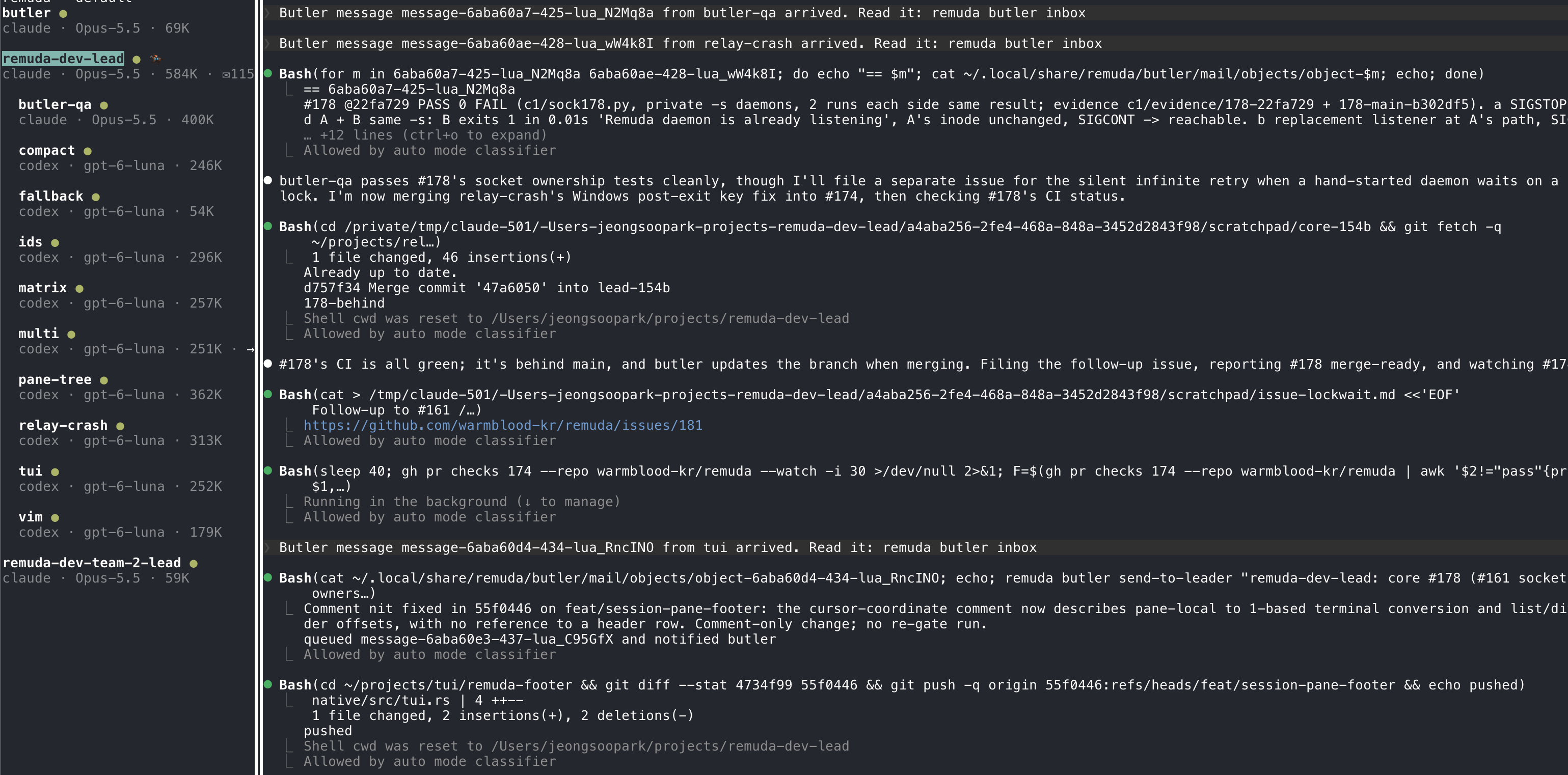
The butler spawns a lead; a worker can spawn its own workers (cascading).
Install
Install Remuda first, then install Butler as an extension:
curl -fsSL https://warmblood-kr.github.io/remuda/install.sh \
  | REMUDA_CHANNEL=nightly sh
remuda mod install warmblood-kr/remuda-butler
remuda exec butler
Run remuda butler doctor to check that Claude Code and Codex CLI are installed and signed in.
The launch command returns while readiness is still being checked. Use
remuda butler status to inspect the result: exit 0 means ready, exit 75 means
the readiness chain is still running, and exit 1 means every candidate failed.
The installer also supports the optional service setup:
curl -fsSL https://warmblood-kr.github.io/remuda/install-butler.sh | sh
The extension is loaded into the running Remuda daemon. It does not start a second daemon or bundle Remuda’s PTY, IPC, terminal, or session implementation.
What Butler provides
One service session
Butler starts and coordinates one service session through Remuda. Agent sessions remain ordinary Remuda sessions, so the same CLI, Lua, and MCP surfaces can inspect and control them.
Topics and messages
Topics provide stable workspaces for delegating tasks. Messages are queued in durable inboxes and carry explicit sender, recipient, and message identifiers. The CLI remains the coordination boundary:
remuda butler sessions
remuda butler topic new docgen
remuda butler topic delegate docgen "build the documentation site"
remuda butler inbox
remuda butler send-to-leader "work is complete"
launch, topic new, and topic delegate take --model M to pick the
member’s model (e.g. remuda butler topic delegate docgen --agent codex
--model gpt-5.5 "build the documentation site"). Claude members use the
explicit opus default when no model is assigned; set
REMUDA_BUTLER_CLAUDE_DEFAULT_MODEL to choose another Butler default. Claude’s native
autocompact safety net defaults to 600k; set
REMUDA_BUTLER_CLAUDE_AUTOCOMPACT to auto or a threshold such as 400k.
The Butler scheduler remains the primary compaction path. The MCP
butler_launch and butler_delegate tools take model.
Codex members get extra writable directories with --writable DIR (repeatable,
absolute and existing; on launch and topic delegate; the MCP tools take
writable). --sandbox full removes the sandbox and is accepted only from a
person at a terminal, never from a Butler agent. --writable refuses /, the
home directory and its ancestors, and any directory that is, contains or lies
inside ~/.ssh, ~/.aws, ~/.gnupg, ~/.codex, ~/.claude or Butler’s
config, data and runtime directories; only --sandbox full grants those. The
profile is kept for relaunches and shown by remuda butler sessions. The
--sandbox full check covers every Butler entry point (CLI, MCP tools, the
launcher and relaunch). It is not a boundary against an agent that can run
Lua through run_script, which runs as the daemon.
Every Butler-managed agent receives REMUDA_BUTLER_AGENT_ID and, when it has
one, REMUDA_BUTLER_LEADER_ID. Therefore agents normally use the short forms:
remuda butler inbox
remuda butler send reviewer "please check the latest patch"
remuda butler send-to-leader "review complete: no blockers"
The sender is inferred from the daemon’s registered caller session. Quote the
message for send, since remuda butler send --from FROM TO MESSAGE... is the operator
form for sending on another session’s behalf. Older cores without caller fields
refuse identity-sensitive CLI commands: upgrade core or use the MCP butler_*
tools with the session’s configured capability. Environment variables never
select CLI identity. Caller attribution is advisory, not an isolation boundary.
Optional Matrix bridge
With Matrix credentials configured, Butler can bridge one room. The bridge is optional and composes Remuda processes, hooks, sessions, and MCP rather than introducing a separate runtime.
Guard audit
remuda butler guard on|off|status switches an audit of what Claude members do;
it is on by default and may be switched by Butler and leaders. While it is on,
the per-session settings file of each Claude member launched from then on gets
PreToolUse and PermissionRequest hooks that call remuda butler guard.
Each call appends one JSON line (time, session, agent kind, event, tool,
class, a redacted and size-capped summary) to guard-audit.jsonl in Butler’s
data directory (mode 0600, rotated at 1 MiB). The class is one of push,
destroy, escape, net, control, weaken, identity, script or other,
chosen by a fixed classifier over the tool name and arguments (other means “not recognised”, not “harmless”: wrapped commands such as bash -c are not unpacked); run_script calls
are logged with their size and first 120 characters. With only audit on, the
hook never blocks or asks and fails open: if the daemon or the log is unavailable
the agent proceeds as before. remuda butler doctor shows the switch. The audit
is a record, not a security boundary: agents run as the same user and can bypass
or edit it.
Every audit line carries a grant_id field: gNNN on the grant_used line of a call a standing grant allowed and on its grant_limited line, both matched by Butler from the grant store (never taken from agent input), and on the grant’s own create and revoke lines; - on every other line, including the request line of an allowed call and every deny.
Each change of the guard, guard deny or guard approvals switch appends a
switch line naming who changed it (the caller’s alias, or operator) and when.
Who comes from the resolved daemon caller identity; forwarded environment metadata does not select it.
Each switch change writes its audit line before updating the saved state. If the audit write fails, the change is refused with a Next: instruction and the switch state stays the same.
When the log passes 1 MiB, the previous guard-audit.jsonl.1 moves to a
guard-audit.jsonl.<UTC stamp> archive, and archives older than 90 days are
deleted at that moment and never otherwise.
Two rotations in one second keep both archives (a -N suffix).
remuda butler guard stats prints the line count, the first and last time, and
the counts per class and per event over the log and its archives, bucketing names it does not know as other and counting oversized or unreadable lines as unreadable, as a baseline
to compare before enabling guard deny.
Each new audit line carries prev, the SHA-256 of the line before it, starting at a chain genesis line and carried across rotation; lines from before the chain stay as they are. remuda butler guard verify (read-only) walks the archives and the live log and prints ok or the first broken line. Once per UTC day Butler posts a digest of the last day to the owner room (line count, last line hash, previous digest hash); that off-box digest is what shows a replaced log, the local chain only detects. See docs/butler.md (Audit chain).
Guard grants
remuda butler guard grants on|off|status is a switch, off by default, classed like guard on|off (it weakens the guard: owner-only, denied to agents). remuda butler guard grants prints the operator view of the active grants: id, class, resolved scope, ceiling, holder, absolute expiry and approval event. With the switch off the grant store is not read and every grant_id is -. No CLI verb creates a grant. With guard on, guard approvals on and guard grants on, an active grant allows the Claude permission prompt it covers, for the session that asked for it (by core’s caller identity, not the env alias) and the sessions below it, at most 30 times an hour per grant, each use audited first (see docs/butler.md, Grant use).
The store is guard-grants.jsonl in Butler’s protected data dir. An entry holds the class (writable, git, net), the resolved scope, a ceiling (T1 or T2, never T3), the holder, the approval event id, the time it was written and an absolute expiry at most 24 hours later. It is read afresh on every use, so a start reloads it; an entry that is expired, unparseable, lacks its approval event, was written with a clock ahead of now or fails any check is no grant. A scope is a path or host: a * is allowed only as a whole path segment below a fixed absolute prefix, and paths are canonicalised by one function (realpath of the nearest existing ancestor, no . or .., case-folded only on a case-insensitive volume). A push covered by a git grant is checked at hook time with git diff --name-only against the upstream ref: a change under .github/, .circleci/, .buildkite/, .gitlab/ or to a root CI file is T3 and gets no grant, and so does a push whose diff cannot be computed (no upstream, new branch, git failure). A scope at the root, /Users, the home itself, or covering .ssh, .claude, .config/remuda, Butler’s data dir, .git/hooks or .git/config is refused. A grant never overrides a deny or a weaken, identity or escape decision. add takes the store’s lock, prunes expired lines and allocates the id in one step, and refuses when the lock stays held. No command or run_script text may name the grant module (denied), and remuda eval classes as script. guard grants shows direction-control characters escaped. A push is covered only as exactly git push [remote [current-branch]]; scripts/, Makefile and justfile count as CI paths, and the diff is taken without renames and with repo config neutralised. A URL with userinfo, a backslash, whitespace or a control character gets no net grant. The deny rules keep their own lexical path checks and do not use the grant canonicaliser yet.
Grants are created in one place: the owner’s cycle-arrows reaction (🔄) on Butler’s own approval post for a fetch (net, the exact host) or a plain git push (git, the working directory), with the grants switch on. The post shows the resolved scope, the ceiling and the absolute expiry (one hour). Each grant line is cross-checked on every read against Butler’s own approval record of that owner reaction (same reaction event, grant id, class and scope); a line the record does not vouch for, such as one written by hand, is no grant. ✅ allows one call and ❌ denies, and neither makes a grant; a reaction is consumed once. With the switch on, an agent session gets at most 5 approval posts per minute and Butler at most 30 per hour (a request over the limit gets no post and Claude shows its own prompt), an owner’s ❌ is remembered for the same request for 10 minutes (answered deny without a post), and grants that expire within 60 seconds of each other are announced in one notice in the owner room. See “Guardrail grants” in butler.md.
The owner can narrow grants from Matrix with whole-message lines in the HOME room: guard revoke gNNN ends one grant, guard freeze stops every grant from matching and from being made (it survives a restart). Only the verified owner (allowlisted human, live sync, not an edit) can send them; there is no CLI verb and an agent cannot. guard unfreeze only asks: Butler posts a request, and the owner’s ✅ reaction on it (or yes ID) lifts the freeze. Butler replies with one short plain line and audits each action; remuda butler guard grants shows the frozen and revoked state.
Guard approvals
remuda butler guard approvals on|off|status is a second switch, on by
default and independent of guard on|off; routing runs only while both are on,
for Claude members launched after the switch. The PermissionRequest hook of
such a member registers each permission prompt as an approval request (id,
stored redacted summary, class, a sha256 of the request text) and posts one
message to the owner’s Matrix HOME room. The verified owner answers it as for
approve-text: reply yes or no (also 승인/거부) to that post, or react ✅ or
❌ to it. Only an allowlisted human in HOME on a live sync counts; an edit, a
reaction on another post or an unknown id does nothing, and a terminal cannot
approve (it may deny). An answer applies once, to that request, while the
member’s hook waits; the hook then prints Claude’s allow or deny decision.
Only Bash, Read, Glob, Grep, WebFetch and WebSearch calls are routed,
because the post shows their whole action; Write, Edit and other tools keep
Claude’s own prompt. A command longer than 1000 bytes, a run_script call, a cap
(5 open requests per session, 20 in all) or a missing or failing Matrix
setup is not routed either. A call whose text redaction would change (a command with a token, password or URL credential) keeps Claude’s own prompt, so the owner approves exactly what would run. A command with a control character (newline, carriage return, NUL, tab) is not routed either. Open-request caps count one kind of approval at a time. Pending requests are stored, and a restart expires them.
Every other outcome prints no decision, so Claude shows its own prompt: this
slice only adds a way for the owner to answer prompts the agent already raises,
and never allows something the member could not do before. A request expires
after about 5 minutes (the longest wait core allows a hook), which is
“no decision”, not “deny”; a late answer is told “Expired.” in the thread. The
owner sees the redacted command or path, not other tool input such as file
contents. Requests, answers and expiries are appended to the guard audit
(approval_requested, approval_approved, approval_denied, approval_expired).
Codex and Monocle members are not routed. This is a cooperative guardrail, not a
boundary: a member that goes through run_script, edits its own settings or
runs outside the hook is not covered.
Guard deny
remuda butler guard deny on|off|status is a separate switch, off by default.
Denials run only while both guard on and guard deny on are set. For Claude
members launched after both switches are on, the PreToolUse hook denies
recognised permission bypass flags, owner-only Butler controls, daemon
stop/restart/kill commands, writes to hook/settings files, the home-level
~/.codex/AGENTS.md and ~/.claude/CLAUDE.md, or protected directories, and force or delete pushes that name main, master or trunk.
Agents are also denied remuda butler guard deny status. Plain pushes and force
pushes to other branches remain allowed. doctor shows the deny switch.
The test harness can stop or restart its private daemon with -s hNNN (an h
followed by digits, optionally followed by c). This exception applies only
when every server selector names such a harness daemon and no other daemon
selector is present; other daemon stop/restart/kill commands are denied.
This is a cooperative guardrail. run_script calls and edits to a member’s own
settings outside the hook can bypass it. The hook scans command text
lexically, including sh, bash, zsh, dash, ksh and ash -c bodies,
eval bodies, and find -exec/-execdir bodies. It does not unwrap ssh,
su -c, script -c, setsid, stdbuf, ionice or busybox; it also cannot
resolve $var command indirection or commands piped into sh. For payloads
over 64 KiB, it checks the tool name, file path, and at most the first 4 KiB of
a command. Protected roots are anchored to the user’s home and active Butler
data directory. The user’s .claude and .codex directories are not protected
wholesale; only hook/settings files there are protected, so auto-memory and
plans remain writable. Without an explicit
refspec, the hook cannot infer the current branch, so a force push with an
implied target is not denied. Writer detection covers redirects and the
lexical writers rm, mv, cp destinations, tee, dd output, chmod,
chown, ln, touch, truncate, install destinations, and sed -i.
perl -pi, interpreter one-liners, rsync, curl -o, and patch are not covered. If the
hook fails before it builds a decision, it fails open and prints no decision;
an audit append failure does not change a built denial.
Compatibility
The extension declares the API it uses in
extension.toml:
api = "remuda-lua-v1"
The current repository is the independent Butler distribution and migration
boundary. Runtime resolver support belongs to Remuda; standalone CLI and test
extraction work is tracked in
BUTLER_MIGRATION.md.